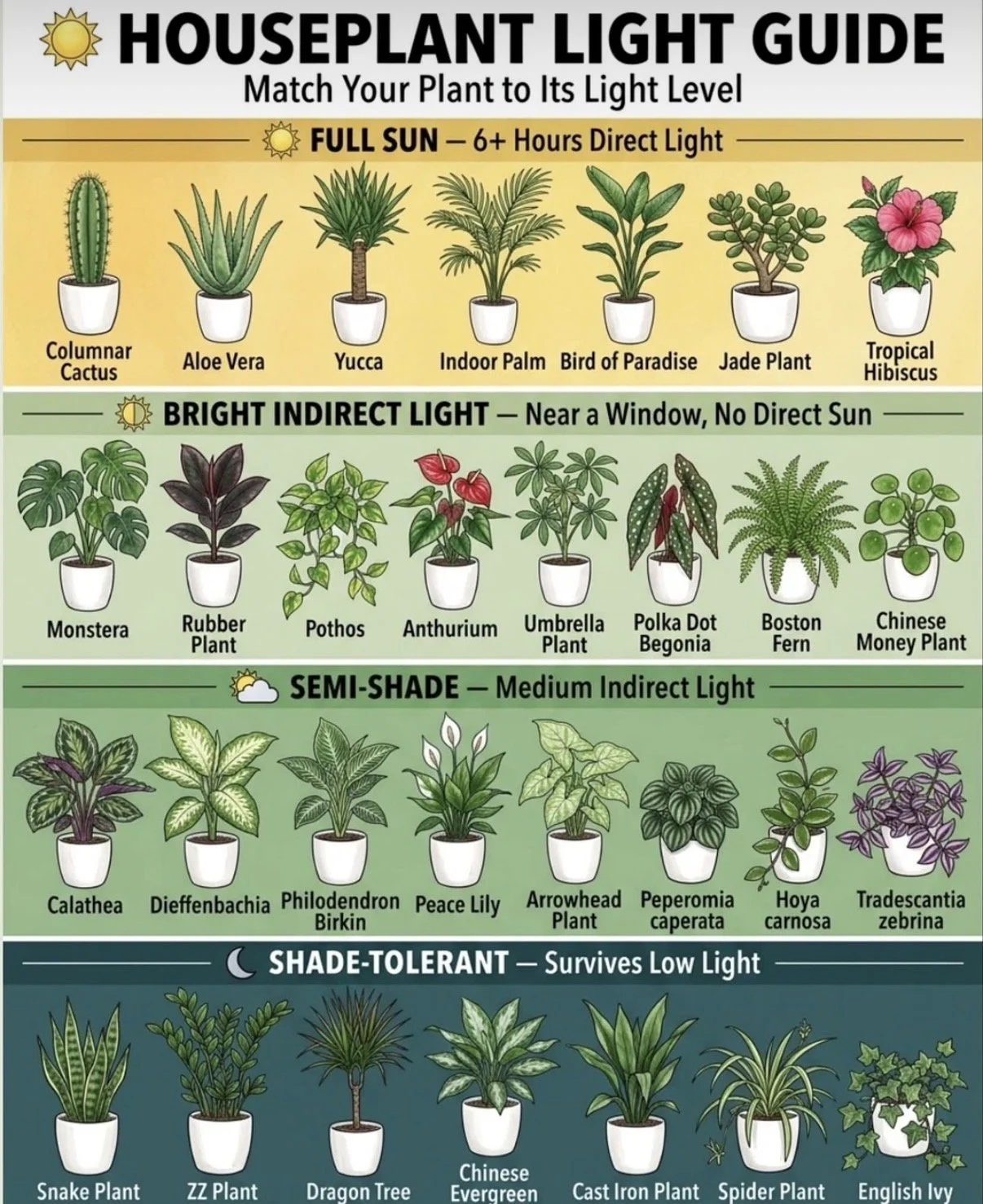
Lighting Recommendations
Understanding Light: The Secret to Healthy Houseplants
One of the most common questions we hear is:
"Where should I put my plant?"
The answer almost always comes down to light.
Watering gets most of the attention, but light is what fuels growth. A plant can survive for a while with improper watering, but without adequate light, it will slowly struggle no matter how carefully it is cared for.
The good news is you do not need a greenhouse or a wall of sunny windows to grow beautiful plants. You simply need to understand the light available in your home and match your plants accordingly.
First Things First: Light Is Different in Every Home
Plant tags often use terms like:
Bright Indirect Light
Medium Light
Low Light
Unfortunately, these labels can be confusing because every home is different.
A bright location in one home may be considered medium light in another.
Factors that affect light include:
Window direction
Time of year
Outdoor trees
Nearby buildings
Window coverings
Weather
Distance from the window
When evaluating light, always consider the plant's location throughout the entire day, not just at one moment.
Understanding Window Directions
South-Facing Windows
South-facing windows usually receive the most sunlight throughout the day.
Best for:
Succulents
Cacti
String of Pearls
Jade Plants
Bird of Paradise
Many Hoya varieties
These locations often provide bright indirect light and may provide direct sun depending on placement.
East-Facing Windows
East-facing windows provide gentle morning sunlight.
Best for:
Monstera
Philodendron
Pothos
Begonias
Calatheas
Peace Lilies
East windows are often considered ideal for many popular houseplants.
West-Facing Windows
West-facing windows receive stronger afternoon sunlight.
Best for:
Hoyas
Succulents
Bird of Paradise
Tradescantia
Many flowering plants
Plants may need to be moved slightly back from the window if afternoon sun becomes too intense.
North-Facing Windows
North-facing windows generally provide the least natural light.
Best for:
ZZ Plants
Snake Plants
Cast Iron Plants
Pothos
Chinese Evergreen
While many plants can tolerate north-facing exposures, growth is typically slower.
What Is Bright Indirect Light?
Bright indirect light is probably the most misunderstood planting term.
A good rule:
Your plant can see the sky, but harsh sun rays are not blasting directly onto the leaves for hours.
Some examples include:
Near an east-facing window
A few feet back from a south-facing window
Behind a sheer curtain
A bright room with plenty of natural light
Many popular tropical houseplants thrive in bright indirect light.
What Is Medium Light?
Medium light is a bright room where the plant sits farther from the window.
Examples:
Several feet from a large window
Rooms with good natural daylight
Offices with consistent natural light
Plants may grow slightly slower in medium light but often remain healthy and attractive.
What Is Low Light?
Low light does not mean no light.
Low light means a plant receives limited natural light but can still see a window or access indirect daylight.
Plants that tolerate lower light include:
Snake Plants
ZZ Plants
Pothos
Aglaonema
Cast Iron Plants
Remember:
No houseplant thrives in a dark closet.
If you cannot comfortably read a book without turning on a light, your plant likely needs additional lighting as well.
Signs Your Plant Needs More Light
Watch for these common indicators:
Leggy Growth
The plant stretches toward light and produces long spaces between leaves.
Smaller New Leaves
New growth emerges much smaller than existing leaves.
Slow Growth
The plant appears healthy but does not produce new leaves for extended periods.
Loss of Variegation
Some variegated plants may begin reverting to greener growth when light levels are too low.
Leaning
The plant consistently grows toward the nearest window.
Signs Your Plant Is Getting Too Much Light
More light is not always better.
Warning signs include:
Scorched Leaves
Brown, crispy patches can develop.
Bleached Appearance
Leaves appear faded or washed out.
Curling Leaves
Some plants curl to reduce moisture loss.
Excessive Drying
Soil dries much faster than expected.
Don't Be Afraid of Grow Lights
Many plant parents assume grow lights are only for serious collectors.
In reality, grow lights can be a simple solution for homes with limited natural light.
Grow lights can help:
Support growth during winter months
Brighten darker rooms
Maintain variegated plants
Supplement natural light
Many modern grow lights are energy efficient and blend seamlessly into home décor.
Seasonal Changes Matter
Light levels change dramatically throughout the year.
During winter:
Days are shorter
Sunlight is weaker
Growth slows naturally
A plant that thrives in one location during summer may appreciate a brighter location during winter.
Pay attention to seasonal shifts and adjust as needed.
The Best Plant Care Tool Is Observation
No online guide can perfectly predict how a plant will behave in your home.
Take time to observe:
How quickly the soil dries
The direction of growth
Leaf color and size
New growth patterns
Plants are excellent communicators if we learn how to read the signs.
Need Help Choosing the Right Spot?
If you're unsure whether your plant is receiving enough light, send us a few photos of:
The plant
Its location in your home
The nearest window
We'll be happy to provide recommendations.